BookingPredict AI
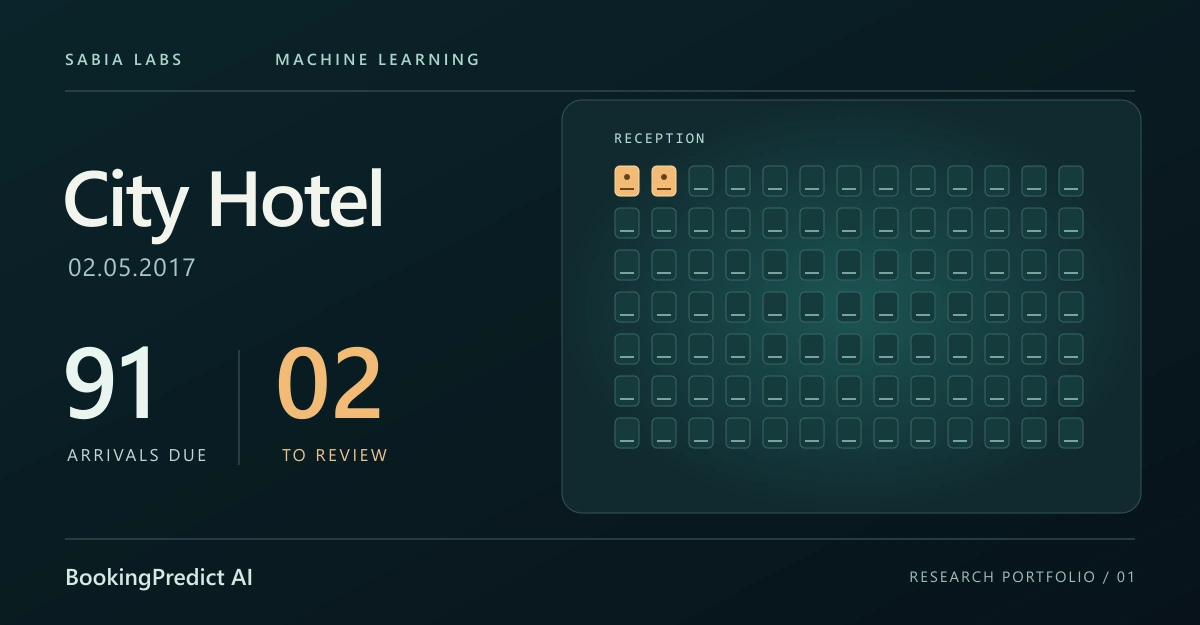
There are 91 bookings due tomorrow. Which should the front desk check first when time is short? BookingPredict AI estimates the risk of a late cancellation or a no-show. Reception staff decide whom to contact.
What it does
A Sabia Labs demonstrator that uses machine learning to help front desk staff decide which bookings to check on the day before arrival.
Who it is for
For front desk teams organising a shift and hotel managers who want to see how useful these flags would be at their own property.
What it simplifies
It ranks existing bookings for review. Staff can see the whole shift and decide whether a particular booking is worth a phone call.
What you can do
- Check the hotel and arrival date before opening an arrivals file.
- Read each booking’s estimated risk alongside the shift average and the review threshold.
- Find the booking reference and record whom to call, whom staff have called and what the guest said.
- Use the technical view to compare models, simulate contact costs and check for changes in the data.
How it works
Staff upload one day of arrivals from a CSV file, check the preview and confirm the shift. The reception view lists all bookings in risk order. After a call, a colleague can read the recorded reply. Whether the guest actually arrived is recorded separately.
One shift at the City Hotel
On 1 May 2017, 91 bookings were still active for the following day. At a 3% threshold the demo flags two. Each has an estimated risk of 5%, against a shift average of 2.1%. The model expects about five late cancellations or no-shows per hundred bookings with that estimate. Arrival is still the more likely outcome for both flagged bookings.
How the model learns
The project uses the public Hotel Booking Demand archive from two Portuguese hotels. It learns from past bookings with known outcomes. Each trial uses only information available on the evening before arrival. Evaluation periods follow those used to train and calibrate the model.
How many events made the shortlist?
We compared three models across four historical periods covering 19,650 bookings and 403 late cancellations or no-shows. With up to three checks per hotel per day, each model selected 1,284 bookings. Logistic regression captured 51 of the 403 events, XGBoost 49 and Random Forest 46. Most events fell outside the lists.
When would a call pay for itself?
In the example, two calls at €2 each cost €4. If each lost booking costs €100 and calls are assumed to prevent a quarter of the events among those contacted, the expected benefit is €2.50. The hypothetical net result is −€1.50. Measuring the effect of calling requires observing interventions and outcomes in practice.
Benchmark source
Public Hotel booking demand datasets by Nuno Antonio, Ana de Almeida and Luis Nunes, © 2018, CC BY 4.0. The demonstration day selects a historical cohort with pseudonymous codes. It does not represent a client hotel’s shift.
What the benchmark covers
This trial concerns cancellations and no-shows among existing bookings. Forecasting new demand and setting room rates are separate tasks. Use at another hotel requires checking the scores against future arrivals there and measuring the costs and outcomes of calls.
Which arrivals would you check at your hotel?
A technical call can start with your shift. How many checks can the front desk make? Which data were available before arrival, and when did the outcome become known? Those answers help define a trial at your property.